
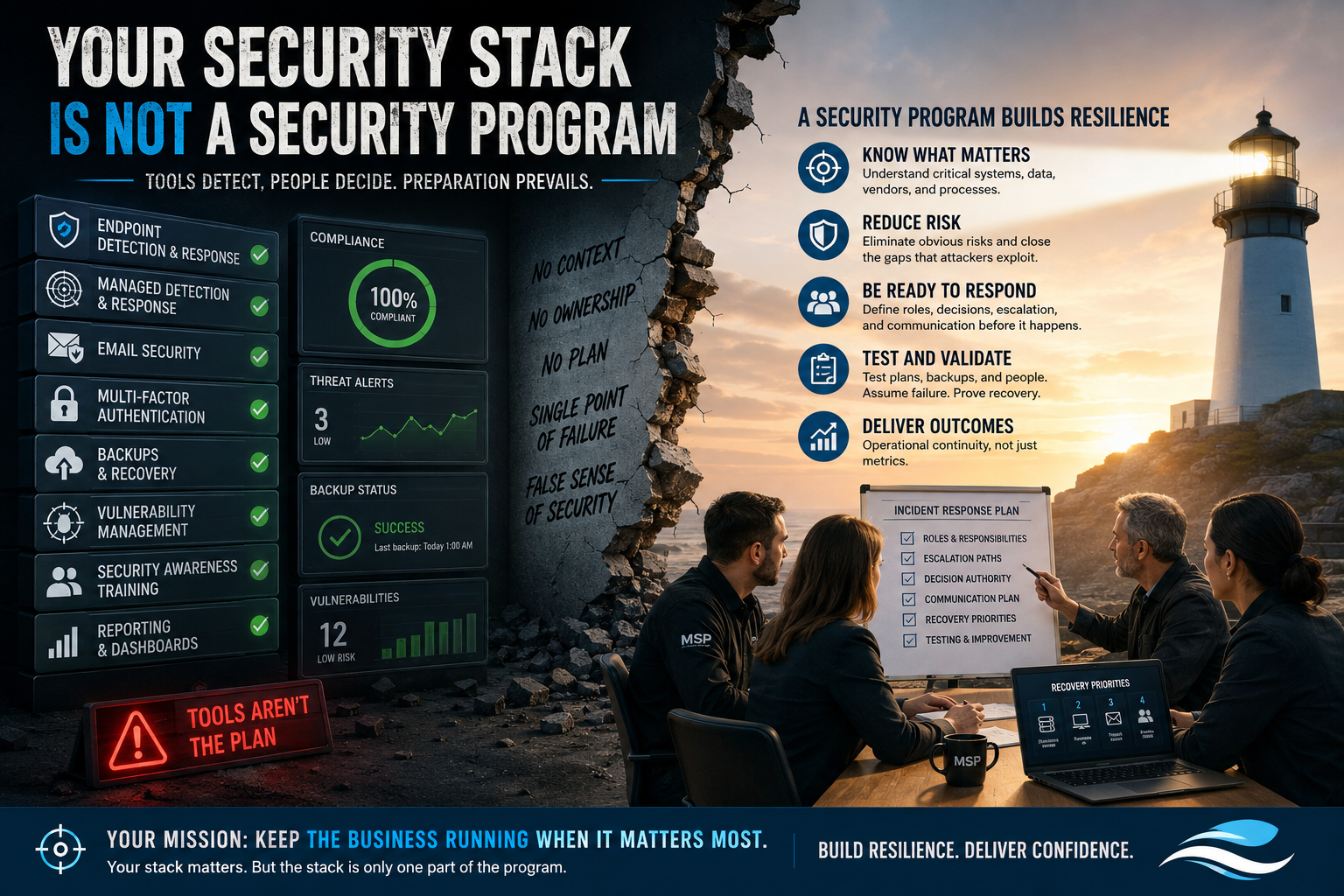
Your Security Stack Is Not a Security Program – Josh Copeland
MSPs rely on tools such as dashboards, integrations, alerts, reports, and automation to reduce technician workload and improve customer outcomes. These tools are essential for scaling operations.
However, many providers now mistake the security stack for a comprehensive security program.
These are distinct concepts.
A customer may have endpoint detection and response, managed detection, email filtering, multifactor authentication, backups, vulnerability scanning, security awareness training, and comprehensive reporting, yet still be unprepared for a real incident. Even with correct deployment, active agents, and dashboards showing full compliance, gaps may remain.
Despite these measures, the business may still fail during a critical incident.
Security Is Not a Collection of Products
Most security discussions start with technology, focusing on antivirus solutions, EDR, backup immutability, and awareness platforms. While important, these should not be the first considerations.
The initial focus should be on the business and its needs.
Which systems must remain operational? What data would cause the most damage if it were exposed, altered, or destroyed? How long can the organization survive without email, billing, scheduling, dispatch, payroll, production, or customer records? Who has the authority to make decisions during an incident? Who communicates with employees, customers, insurers, regulators, and law enforcement? What happens when the MSP’s normal tools are unavailable?
A security product can generate alerts, but it cannot determine whether to stop production, shut down a business unit, notify customers, invoke cyber insurance, or rebuild critical environments. These decisions require context, preparation, and leadership.
This distinction separates operating security tools from managing a comprehensive security program.
The Dashboard Is Not the Mission
MSPs often track metrics that are easily accessible through their tools, such as patch compliance, endpoint coverage, phishing click rates, backup success, vulnerability counts, alert volume, ticket closure rates, and response times.
While important, these metrics can create a false sense of security.
A backup job may report success nightly yet fail during recovery. EDR agents may be installed on all laptops while critical infrastructure remains unmanaged. Vulnerability scanners may generate numerous findings without identifying those that directly threaten essential systems. Phishing programs may reduce click rates, but executives may still approve payments through insecure or undocumented processes.
The objective is not just to achieve positive dashboard metrics.
The mission is to ensure the customer can continue operations under pressure.
Achieving this requires a thorough understanding of the business, including critical systems, hidden dependencies, potential single points of failure with third parties, and processes vulnerable when technology is unavailable.
The MSP Should Know What Breaks First
Every customer has a different failure point. For a medical practice, it may be patient records and scheduling. For a manufacturer, it may be production control systems. For a law firm, it may be access to confidential client files. For a logistics company, it may be dispatch, routing, and fleet communications.
An MSP should be able to describe the first four hours of a serious incident from both technical and operational perspectives for each customer.
Who notices the problem? Who gets called first? Who has administrative access? Which systems are isolated? What evidence must be preserved? Which business functions can continue manually? What is the recovery order? Who can authorize downtime, customer notification, emergency spending, or engagement with outside counsel?
If only one senior technician holds this knowledge, the customer lacks effective incident response capability and is dependent on a single individual.
If the MSP cannot answer these questions, it does not fully understand the environment it is tasked with protecting.
Build Around Outcomes
A practical security program does not require a large framework or extensive policy manual to begin. It should start with clearly identifying what is most important. Determine which systems, data, vendors, identities, and processes have the greatest operational, legal, or financial impact.al impact.
Mitigate obvious risks by enforcing multifactor authentication, removing unnecessary administrative access, patching exposed systems, protecting backups, retiring unsupported technology, and eliminating weak exceptions or overrides.
Establish response procedures by defining roles, escalation paths, decision authority, communication protocols, and recovery priorities in advance of an incident.
Validate the plan’s effectiveness by testing backups, conducting tabletop exercises, simulating account compromise, verifying emergency contacts, and ensuring technicians can recover systems without standard access or documentation.
This is where MSPs provide value that cannot be replicated by additional software.
Sell Confidence, Not Fear
Security sales often rely on fear, emphasizing threats such as ransomware and pervasive attackers.
While these risks are real, fear alone is not a strategy. Customers need an MSP that can translate technical risk into business decisions. They need someone who can explain what matters, what should be fixed first, what risk remains, and what the organization will do when prevention fails.
The most effective MSPs are not those with the most extensive product offerings.
They are those who understand their customers well enough to ensure operational continuity in critical incidents.
Your stack matters.
However, the stack is only one part of the overall program.
The true objective is operational resilience.
